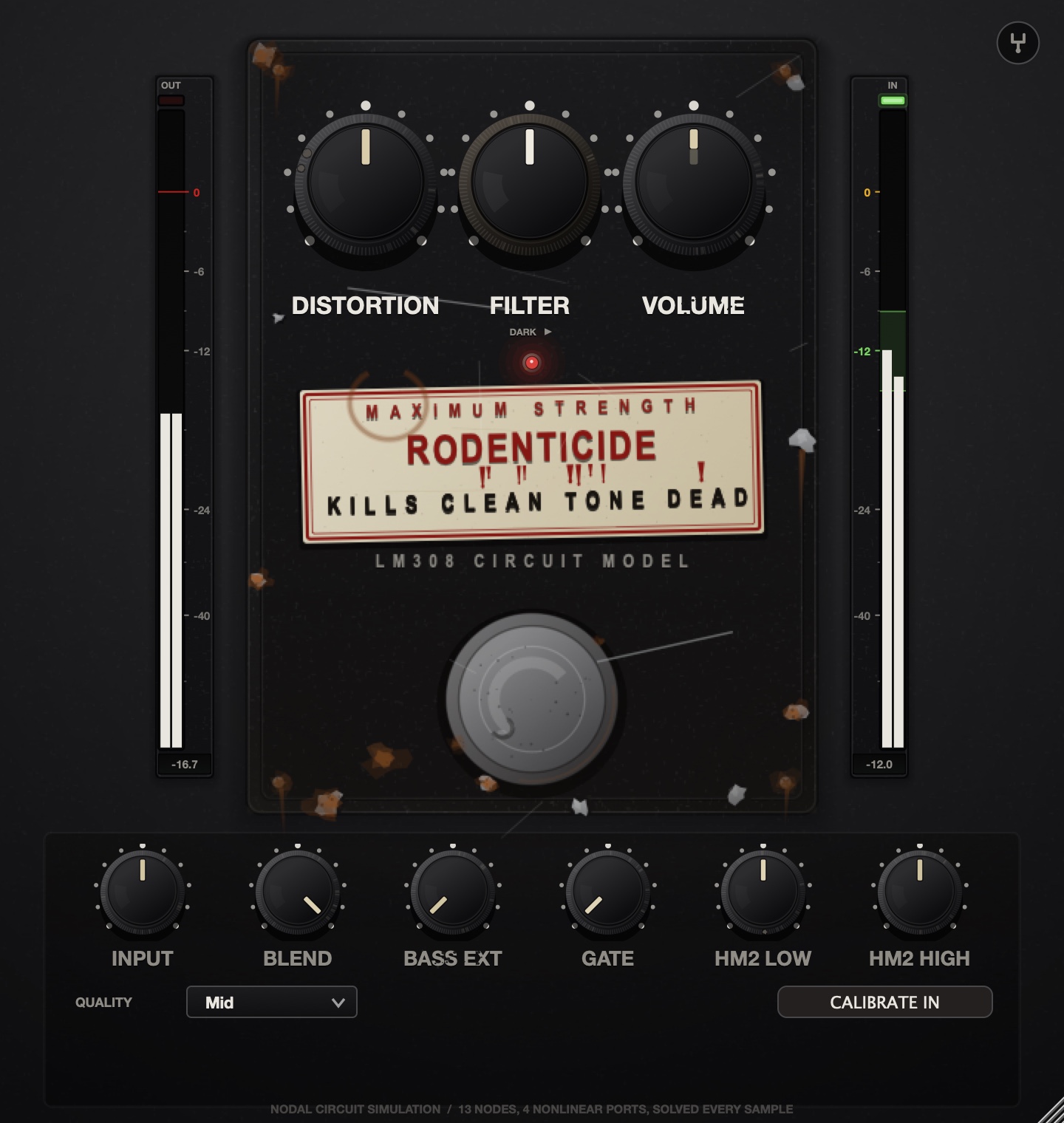
What it actually does
Thirteen nodes and four nonlinear ports, solved every sample. Not a waveshaper wearing a RAT's clothes.
The LM308, slew and all
The RAT's character is an op-amp too slow for the job. The model is a slew-limited single-pole macromodel — 0.3 V/µs from the datasheet — so the softening on fast transients falls out of the circuit instead of being drawn on afterwards.
Clipping in the feedback loop
The diodes sit where the schematic puts them: across the feedback path, not across the output. The op-amp fights them, and that argument is what you hear.
FILTER, wired backwards
The real pot is reversed — clockwise is darker. The model keeps it that way, and says so on the panel.
HM-2 EQ on a switch
The Raging Beaver's gyrator tone stack, built in as an extra EQ. Flat at noon -- leave it centred and it is a RAT.
Blend and bass extension
Two modifications the pedal never shipped with but every tech has done: a dry blend, and the input cap opened up so the low end survives the clipper.
Gate and tuner
The same THAT4301-style expander and the same chromatic tuner the Raging Beaver ships — one shared source, so both plugins always agree.
Hear it
“Black Rain” by Where Deprivation Lies, from the band’s own DI multitrack. The same song three ways, so you can hear what the pedal does on its own and what the rest adds.
Full mix
Rhythm guitars, bass and vocals through Rodenticide, the lead guitar through Raging Beaver, and the guitars then through Bogren Digital Ampknob 6606.
Guitars only, into an amp sim
The rhythm guitars through Rodenticide, then Bogren Digital Ampknob 6606, the same chain the full mix uses. Nothing else: no drums, bass or vocals.
Guitars only, Rodenticide alone
The same guitars through Rodenticide and nothing after it. No amp sim, no cabinet, so this is the pedal on its own.
Where Deprivation Lies: Danny Greenwood and Jack Willitts, guitars · Chris Kemp, vocals · Martin Mullineaux, bass. Music by Danny Greenwood, lyrics by Jack Willitts, engineered by Danny Greenwood. Original production, mixing and mastering by Jan Trtschka at Xenotype Mixing, who released the multitrack. Band on Facebook. Used with thanks; the song is theirs.
How it was checked
Two engines, one reference, and a gate that decides what ships.
Two engines that must agree
A wave-digital engine runs in the plugin. A full nodal solve of the same schematic — written for correctness and nothing else, no shortcuts anywhere — is the reference it is validated against. Every optimisation has to survive a comparison with that reference or it is reverted, and several were.
Against a simulator
Bias points and transient response are compared with ngspice running the same netlist, so the model is anchored to something outside its own assumptions.
Against real pedals
Captures of real hardware were used as a fitting target, and the model is compared with them on held-out material it was never fitted to.
Stated plainly, because it matters: captures of a distortion pedal disagree with each other by a similar margin to how much the model disagrees with any one of them — different units, different days, different levels. That is a limit of the comparison, not a licence to claim the model is indistinguishable from a particular RAT. What it does say: the model lands inside the spread that real captures of the real pedal already occupy.
What it costs
About 2.7% of one CPU core at 48 kHz, in the shipping quality setting.
Download & Purchase
Free for 14 days from the first time you open the plugin. Purchase for perpetual access on up to five machines.
The macOS installer is signed and notarised by Apple, so it installs without warnings.
The Windows installer is code-signed and installs the VST3 version.
The trial starts the first time you open the plugin's interface, not when you install it, so installing early costs you nothing. Bought during the trial? Click the trial badge at the bottom right of the plugin and paste your key.
Requires macOS 11.0 or later (Apple Silicon and Intel), or 64-bit Windows 10 or later.