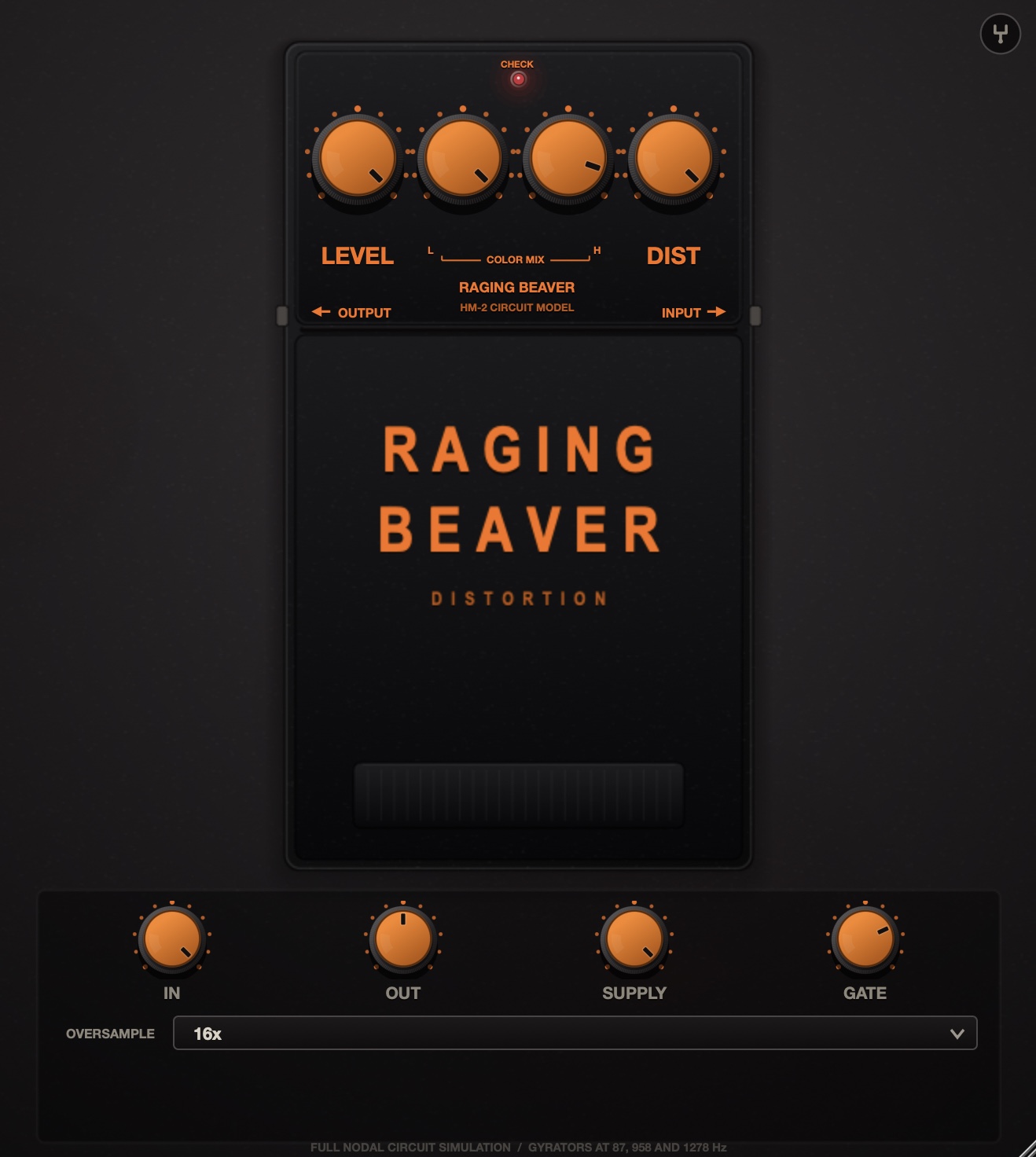
What it actually does
Not a waveshaper with a tone control bolted on. A nodal solve of the real schematic.
Full Gummel-Poon
All four transistors run the complete SPICE model — Early effect, high-current beta rolloff, base-emitter recombination leakage.
The germanium pair
Modelled where it actually sits: in series with the signal, softest around zero and stiffening as the note swells. That is what makes the decay sputter rather than fade.
COLOR MIX
Three real gyrators at 87, 958 and 1278 Hz — confirmed against a real Made-in-Japan black label, matching to three figures.
Supply voltage
4–12 V, and it re-solves every bias point. A real HM-2 does open up on 12 V.
Noise gate
Modelled on the THAT4301 expander used in the Marshall 2203KK. One knob, fully counter-clockwise is off.
Chromatic tuner
Accurate to 0.09 cents, down to 31 Hz. Works with the pedal bypassed, which is the normal case.
Hear it
“Black Rain” by Where Deprivation Lies, mixed from the band’s own DI multitrack. The lead guitar goes through Raging Beaver, the rhythm guitars, bass and vocals through Rodenticide, and the guitars then through Bogren Digital Ampknob 6606. The Rodenticide page has two more versions of this track: the guitars alone, with and without the amp sim.
Where Deprivation Lies: Danny Greenwood and Jack Willitts, guitars · Chris Kemp, vocals · Martin Mullineaux, bass. Music by Danny Greenwood, lyrics by Jack Willitts, engineered by Danny Greenwood. Original production, mixing and mastering by Jan Trtschka at Xenotype Mixing, who released the multitrack. Band on Facebook. Used with thanks; the song is theirs.
Measured against the real pedal
A Made-in-Japan black label was put on a bench and compared with the model, driven by the same signals through the same interface.
The tone stack
Swept response of the real unit against the model's claimed corner frequencies:
| Gyrator | Measured on the pedal | In the model |
|---|---|---|
| Low | 87 Hz | 86.8 Hz |
| Mid | 958 Hz | 958.0 Hz |
| High | 1278 Hz | 1278.0 Hz |
Playing through it
Twenty seconds of real guitar through the pedal, and the identical signal through the model. Level-matched, then switched between the two every two seconds with a short crossfade so the join itself is silent.
The owner of the pedal could not hear the switches.
Honest limits, because they matter: one setting — everything up, which is the setting this pedal is known for — one twenty-second passage, driven through a reamp rather than a real pickup. It is a switch test, not a formal ABX. It does not license the claim "indistinguishable from a real HM-2" in general. It does say the remaining difference is below what the owner could pick out on his own hardware.
Against a simulator
Every DC bias point lands within 3.4 mV of ngspice running the same netlist.
Download & Purchase
Free for 14 days from the first time you open the plugin. Purchase for perpetual access on up to five machines.
The macOS installer is signed and notarised by Apple, so it installs without warnings. It offers VST3, Audio Unit, CLAP and a standalone app as separate checkboxes — install only what your DAW uses.
The Windows installer is code-signed and installs the VST3 and CLAP versions. There is no Audio Unit on Windows (it is an Apple format), and no standalone or AAX build yet.
The trial starts the first time you open the plugin's interface, not when you install it, so installing early costs you nothing. Bought during the trial? Click the trial badge at the bottom right of the plugin and paste your key.
Requires macOS 11.0 or later (Apple Silicon and Intel), or 64-bit Windows 10 or later.